By WDEP Radio Sports
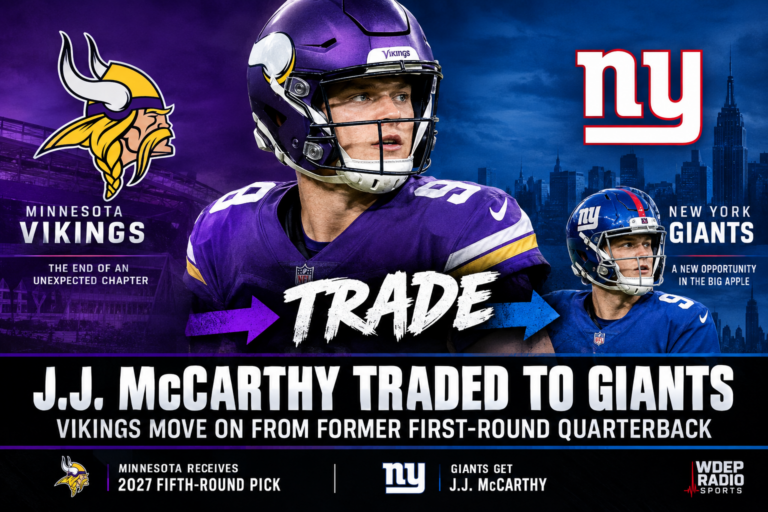
The Minnesota Vikings have officially moved on from J.J. McCarthy, trading the former first-round quarterback to the New York Giants for a 2027 fifth-round draft pick.
The Vikings announced the deal on September 28, bringing an unexpected end to McCarthy’s tenure in Minnesota less than two and a half years after the organization traded up to select him No. 10 overall in the 2024 NFL Draft.
The trade came after the Giants lost quarterback Jaxson Dart for the remainder of the regular season because of a knee injury. New York was looking for additional quarterback depth, while Minnesota had already moved forward with Kyler Murray as its starter and Carson Wentz ahead of McCarthy on the depth chart.
A Short and Complicated Vikings Career
McCarthy’s time in Minnesota never developed the way either side had envisioned.
The Vikings selected him after moving up one spot in the 2024 draft. The organization believed the Michigan product could eventually become its long-term answer at quarterback.
Instead, injuries immediately disrupted his development.
McCarthy suffered a knee injury during the preseason of his rookie year and missed the entire 2024 season. He eventually returned to the field in 2025, but injuries and inconsistent play limited his opportunities. In his 10 career starts for Minnesota, McCarthy completed 57.6% of his passes for 1,632 yards, 11 touchdowns and 12 interceptions, according to NFL.com.
The lack of consistent playing time became a major obstacle.
A recent Minnesota Star Tribune analysis noted that McCarthy entered the NFL with considerably less college passing experience than many of his fellow 2024 quarterback prospects. His development was further complicated by injuries, the complexity of Minnesota’s offensive system and the Vikings’ desire to compete immediately.
The Vikings’ Quarterback Plan Changed
Minnesota’s decision to sign Kyler Murray this offseason was another significant development.
Murray ultimately won the starting job during training camp, while McCarthy struggled to establish himself as the team’s primary backup. The Vikings then signed veteran Carson Wentz, further reducing McCarthy’s role.
By the beginning of the season, McCarthy had been relegated to an emergency third-quarterback role.
That made the eventual trade increasingly likely.
NFL.com reported that Minnesota’s decision also cleared roughly $4.5 million from its books.
For the Vikings, the move represents the end of an expensive developmental experiment and the beginning of another chapter at quarterback.
Why the Giants Made the Move
For New York, McCarthy represents an intriguing opportunity.
The Giants weren’t simply acquiring a veteran backup. They were bringing in a 23-year-old former top-10 pick who still has the potential to become a starting quarterback.
New York currently has Jameis Winston as its starting quarterback, with McCarthy joining the quarterback room after Dart’s injury.
Head coach John Harbaugh has already said Winston will start against Arizona, meaning McCarthy isn’t immediately being handed the job.
The Giants can therefore bring McCarthy along without immediately putting the entire offense on his shoulders.
There’s also an interesting connection: McCarthy played his college football at Michigan under Jim Harbaugh, while John Harbaugh is Jim’s brother.
Whether that familiarity ultimately helps McCarthy remains to be seen, but New York is clearly betting that the former No. 10 overall pick still has something to offer.
A Fresh Start for McCarthy
The Giants trade gives McCarthy something he never consistently had in Minnesota: a clean slate.
His Vikings tenure was defined by expectations, injuries, limited opportunities and the pressure that comes with being a first-round quarterback.
Now he enters an organization where expectations are different.
He doesn’t have to immediately prove that Minnesota made a mistake. He simply has to learn a new offense, adjust to his new surroundings and take advantage of whatever opportunities come his way.
The Giants will have time to evaluate whether the quarterback they acquire is capable of becoming more than a backup.
What Happens Next in Minnesota?
The trade also leaves the Vikings facing another long-term quarterback question.
Murray is currently Minnesota’s starter, but his contract situation means the Vikings will eventually have to determine whether he is the long-term answer or whether another quarterback search is necessary.
The Star Tribune reported that Minnesota could face another significant quarterback decision after this season, potentially involving Murray and the 2027 draft.
That means the McCarthy trade doesn’t necessarily end Minnesota’s quarterback uncertainty.
It simply changes the conversation.
The Bigger Picture
The McCarthy era in Minnesota will ultimately be remembered as one of the organization’s most unusual quarterback experiments.
The Vikings invested a top-10 selection in a quarterback they believed could develop into their future, only to see injuries and inconsistent performance prevent him from getting the extended runway normally associated with such a high draft pick.
Head coach Kevin O’Connell acknowledged that the decision to trade McCarthy was difficult and said he and General Manager Nolan Teasley considered the human side of the move.
For McCarthy, the Giants represent another opportunity.
For the Vikings, the fifth-round pick represents the tangible return on an investment that never reached its intended destination.
And for both organizations, the real story won’t be known for years.
McCarthy now gets the chance to write the next chapter of his career in New York.
The Vikings, meanwhile, must figure out what comes next at the most important position on the field.
WDEP Radio Sports — Where the Game Never Stops.