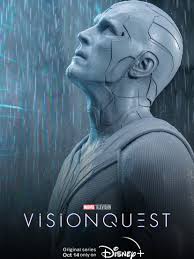
WDEP Radio TV Review
Rating: 9/10
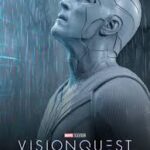
VisionQuest takes a major step forward in its second episode, “Theseus,” delivering a compelling blend of superhero action, emotional storytelling, and philosophical questions about what makes someone human. With Vision confronting the possibility that Thomas Shepherd is his long-lost son, Tommy, the episode transforms a mysterious connection into a desperate fight for survival.
The result is one of the series’ most emotionally significant chapters so far, anchored by Paul Bettany’s thoughtful performance, James Spader’s scene-stealing return as Ultron, and a heartbreaking sacrifice that changes the dynamic inside Vision’s mindscape.
A Father’s Impossible Choice
The episode’s central conflict revolves around Vision’s decision to rescue Thomas Shepherd, whose memories suggest that he carries the consciousness of Tommy Maximoff, Vision and Wanda’s son.
Thomas’s backstory adds welcome emotional depth. After experiencing a traumatic near-death incident, he begins recalling fragments of another life, including memories of Wanda, Vision, and Westview. Unable to understand what is happening to him, Thomas finds himself caught in a system that treats his experiences as a problem rather than trying to understand them.
His connection with Lisa Molinari offers a glimpse of the person beneath the confusion. Their shared struggles establish a genuine bond, while Thomas’s emerging abilities suggest that his unusual memories are only one part of a much larger mystery.
Ruaridh Mollica gives Thomas a vulnerable, restless quality that makes his predicament believable. He is not simply a convenient plot device designed to bring Vision back into action; he is a young man struggling to understand who he is.
Vision’s Identity Crisis Takes Center Stage
Vision’s search for Thomas is also a search for himself.
This version of Vision possesses memories from his predecessor, but possessing those memories does not automatically restore the compassion, emotional understanding, or moral certainty associated with the original character. He can analyze a situation with extraordinary precision, yet he struggles to understand what his connection to Thomas should mean to him.
That conflict becomes the episode’s strongest thematic element. Vision wants to believe he can live up to the person he remembers being, but his current identity is shaped by different experiences and a growing willingness to use lethal force.
When Vision decides to enter St. Mabyn’s to rescue Thomas, he makes a choice that goes beyond logic. He is acting on a possible family connection that he cannot fully explain, and that uncertainty makes the decision more meaningful.
The series uses this dilemma to ask an intriguing question: If memories can survive the destruction of a body, and a person can be reconstructed from pieces of a former self, what actually makes that person who they are?
Ultron Remains the Show’s Most Fascinating Wild Card
James Spader continues to be one of VisionQuest’s greatest assets.
Ultron remains dangerous, manipulative, and deeply unpredictable, but his relationship with Vision has evolved into something more complicated than a conventional hero-versus-villain rivalry. Their conversations are filled with sharp humor, philosophical challenges, and an uncomfortable familiarity.
Ultron understands Vision’s insecurities well enough to know which buttons to push. Rather than simply encouraging violence, he challenges Vision’s tendency to define himself by the ideals of the original Vision.
His advice about the Ship of Theseus paradox gives the episode its philosophical backbone. If Vision is no longer exactly the person he once was, perhaps he must stop trying to reproduce someone else’s identity and decide what kind of person he will become now.
Ultron’s suggestion that Vision should stop worrying about being the ship and start acting like the king is both darkly funny and revealing. He offers Vision a way forward, but it is a way forward shaped by Ultron’s own ruthless worldview.
Their relationship remains fascinating because neither character can completely dismiss the other. Vision may consider Ultron a prisoner, but Ultron continues to influence how he sees himself.
The Rescue Mission Raises the Stakes
The operation at St. Mabyn’s delivers the episode’s biggest burst of action. Vision enters the facility knowing it is likely a trap, only to discover that his enemies have prepared weapons specifically designed to neutralize his advantages.
The resulting confrontation forces him into unfamiliar territory. Vision is accustomed to being one of the most powerful beings in the room, but the facility’s defenses and Paladin’s specialized ammunition expose vulnerabilities that raw strength cannot overcome.
Todd Stashwick makes Paladin an effective physical threat, bringing a cold professionalism to the bounty hunter. His mission is not simply about defeating Vision in combat; it is about exploiting Vision’s attachment to Thomas.
The action is effective because it has consequences. Vision’s injuries threaten not only his physical survival but also the stability of the digital world in which his artificial-intelligence companions reside.
The sequence connects the show’s science-fiction spectacle to its emotional stakes. Every blow against Vision puts more than one character in danger.
J.A.R.V.I.S.’s Sacrifice Is the Episode’s Emotional High Point
The episode’s most devastating moment comes when J.A.R.V.I.S. chooses to sacrifice himself to preserve the others as Vision’s internal systems begin to fail.
His decision gives the episode its emotional weight. J.A.R.V.I.S. has served as a stabilizing presence within Vision’s world, and his final act demonstrates that his loyalty is more than a programmed function. Faced with the possible destruction of his companions, he makes a deliberate choice to save them.
The sacrifice also reinforces one of the series’ central ideas: humanity may be defined less by biological origins than by the decisions a person makes when someone else’s life is at stake.
The scene is particularly effective because it does not rely on a grand speech to manufacture emotion. The act itself carries the meaning, and the consequences are immediate.
For a series concerned with the boundaries between artificial intelligence and human feeling, J.A.R.V.I.S.’s decision is a powerful statement about devotion, family, and selflessness.
A Reunion That Raises More Questions Than It Answers
Vision’s rescue of Thomas does not immediately produce the emotional reunion that audiences might expect.
Thomas senses a connection but cannot fully explain it. Vision, meanwhile, remains uncertain about what their relationship means and what kind of future they might have together.
That uncertainty is a strength. The episode does not pretend that shared memories automatically create trust or that a complicated identity crisis can be resolved through one dramatic encounter.
Thomas’s decision to return and help Vision escape is an important development. Despite his fear and confusion, he refuses to abandon someone he instinctively believes is connected to him.
The episode closes with the possibility of a family bond beginning to take shape, while Ultron’s new freedom within Vision’s mindscape introduces another complication. The rescue may have saved Vision and Thomas from immediate danger, but it has also changed the balance of power inside Vision’s own mind.
What Works—and What Could Be Better
The episode’s greatest strengths are its character work, thematic consistency, and willingness to make its action consequential. Bettany and Spader remain an excellent pairing, while Mollica gives Thomas enough emotional grounding to make his storyline matter.
The principal weakness is that the episode has a lot of mythology to explain. The mechanics of Thomas’s identity, Vision’s internal world, and the specialized technology used against him can occasionally compete with the emotional story. Viewers unfamiliar with WandaVision and Agatha All Along may find some of the connections difficult to follow.
Still, the episode largely succeeds because its central conflict is easy to understand: Vision must decide whether to risk everything for someone who may be his son, even though he is no longer certain who he is himself.
Final Verdict
“ Theseus” is a strong second episode that gives VisionQuest a clearer emotional direction. The rescue mission supplies the action, Thomas’s story expands the mystery, and Ultron’s increasingly complicated relationship with Vision provides the sharpest dialogue.
But the episode’s lasting impact comes from its questions about identity and family. Vision cannot simply recover the person he once was, and Thomas cannot instantly understand the life whose memories have become part of him. Both characters must decide what those connections mean in the present.
J.A.R.V.I.S.’s sacrifice provides the hour’s emotional centerpiece, while the escape leaves Vision and Thomas facing an uncertain future with Ultron now playing an even more dangerous role.
VisionQuest is at its best when it balances Marvel spectacle with meaningful character drama. “Theseus” does exactly that, delivering a tense, thoughtful, and unexpectedly moving chapter.
WDEP Radio Verdict: 9/10 — A gripping episode elevated by Ultron’s sharp dialogue, Vision’s identity crisis, and a heartbreaking sacrifice that gives the series real emotional stakes.