By WDEP Radio News
October 3, 2026
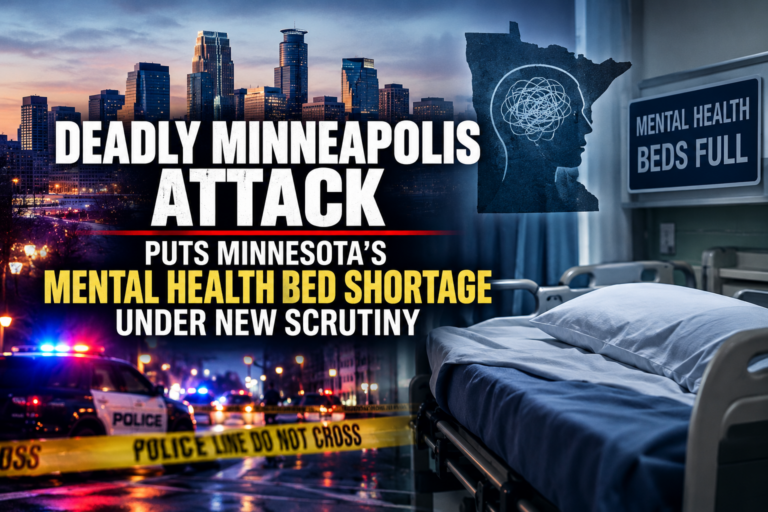
A deadly attack at a Minneapolis residential mental health facility is renewing questions about whether Minnesota has enough secure treatment beds and other options for people experiencing serious mental illness.
The case centers on the death of 23-year-old Bruce Hayes, who was killed earlier this week at a People Incorporated mental health facility in Minneapolis. Four other people were injured.
A 31-year-old Zimmerman man, Derek Faulkner, has been charged in connection with the attack. According to reporting from KSTP, Faulkner was also facing separate attempted-murder and assault charges stemming from incidents in Sherburne and Anoka counties in August and September.
The circumstances have prompted Hayes’ family and others to question whether Faulkner should have been receiving treatment in a more secure setting.
Questions About Minnesota’s Mental Health System
Former Hennepin County Sheriff Richard Stanek told KSTP that Minnesota has struggled for years with limited treatment options for people with severe mental illness.
One of the problems, he said, is that county jails can effectively become the state’s largest mental health institutions when appropriate treatment beds aren’t available.
Minnesota’s system includes secure state-operated facilities as well as hospitals, residential programs and community-based services. But determining where someone should receive treatment can depend on court orders, clinical assessments, available beds and the person’s legal status.
The state has also faced longstanding challenges placing people who have been civilly committed into appropriate treatment settings. Minnesota Management and Budget says the state has struggled since 2013 to place civilly committed individuals in medically appropriate beds, contributing to lengthy waits for services.
What Happens When Someone Is Found Mentally Ill and Dangerous?
Minnesota law distinguishes between a person who is legally determined to be mentally ill and someone who meets the higher standard of being mentally ill and dangerous.
That distinction can have significant consequences for where a person receives treatment.
People committed to Minnesota’s secure treatment system may be sent to state-operated facilities designed for individuals requiring a higher level of supervision and care.
The Minnesota Department of Human Services operates Community Behavioral Health Hospitals in six communities. The locked facilities provide short-term inpatient behavioral health treatment, including psychiatric care, medication management, 24-hour nursing and discharge planning. The state says the hospitals have 16 beds each and that patients stay an average of about 60 days.
But those facilities serve only part of the state’s broader behavioral health system.
A Shortage That Goes Beyond Hospital Beds
The shortage of appropriate mental health placements isn’t simply about the number of beds inside psychiatric hospitals.
Minnesota’s behavioral health system also depends on crisis programs, residential treatment, outpatient services, supportive housing and ongoing community care.
When one part of that system is full, the pressure can move elsewhere — including emergency rooms, county services and correctional facilities.
The Minnesota Department of Health has been monitoring the expansion of inpatient mental health beds following legislation that created an exception to the state’s hospital moratorium for certain mental health projects. The department is also studying access to and the quality of inpatient mental health care, with a report planned for 2027.
State Task Force Called for Changes
The latest controversy also comes after a state task force examined Minnesota’s civil commitment process.
Among the recommendations was creating a secure, state-run setting where people undergoing the legal commitment process could be observed and stabilized before being placed in longer-term treatment.
The task force also recommended developing community-based locked settings for people who require 24-hour supervision but may not need a traditional state hospital.
Supporters of those changes argue that Minnesota needs more options between traditional hospitalization, community treatment and incarceration.
DHS Investigating the Facility
The Minnesota Department of Human Services is also investigating the People Incorporated facility following Hayes’ death.
State records cited in KSTP’s report show DHS previously reviewed critical incident reports involving five People Incorporated facilities. A February 2026 correction order cited multiple incidents that were reported late.
DHS said the earlier review did not identify resident-safety, staffing, supervision or operational concerns connected to the incident beyond the late-reporting violation.
Following the latest attack, however, DHS said a maltreatment investigation is underway at the Nancy Page program. The agency said it could not provide additional details while the investigation remains open.
A Broader Conversation
The tragedy has placed renewed attention on a difficult question facing Minnesota: how to provide appropriate treatment for people experiencing serious mental illness while also protecting patients, staff and the public.
There is no single solution.
Expanding secure beds could address some placement problems, but mental health professionals and policymakers have also emphasized the importance of earlier intervention, crisis services, residential programs and sustained treatment after hospitalization.
Minnesota already provides mobile crisis response and residential crisis services through its behavioral health system. The state says mobile crisis teams are available around the clock and can respond in homes or other community locations.
For Hayes’ family, however, the broader policy debate is now tied to a deeply personal loss.
His death is prompting renewed scrutiny of a system that families, law enforcement officials, courts and mental health providers have warned for years can leave people waiting for care when they need it most.
As the criminal cases against Faulkner move forward and the DHS investigation continues, questions about Minnesota’s mental health infrastructure are likely to remain in the spotlight.
For WDEP Radio News, this story underscores the need to examine not only what happened during one deadly incident, but also whether Minnesota has enough treatment options available before another crisis reaches that point.