Rating: 7.5/10
Spoiler Warning: This review discusses major plot points from Don’t Move.
Don’t Move is built around a wonderfully cruel premise: What if you were being hunted by a killer while your body was gradually losing the ability to move?
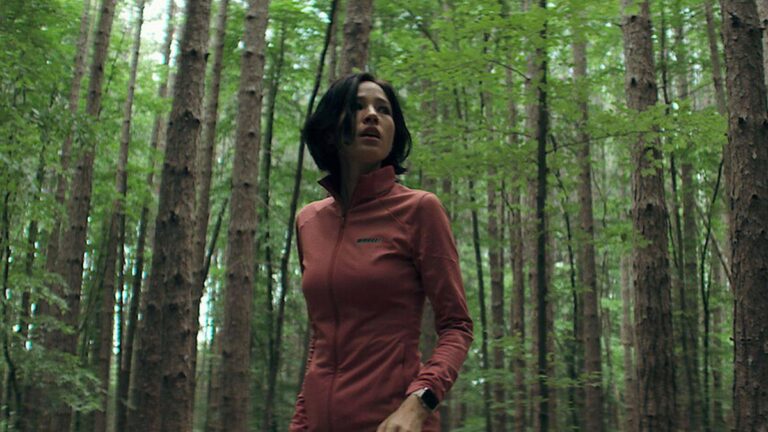
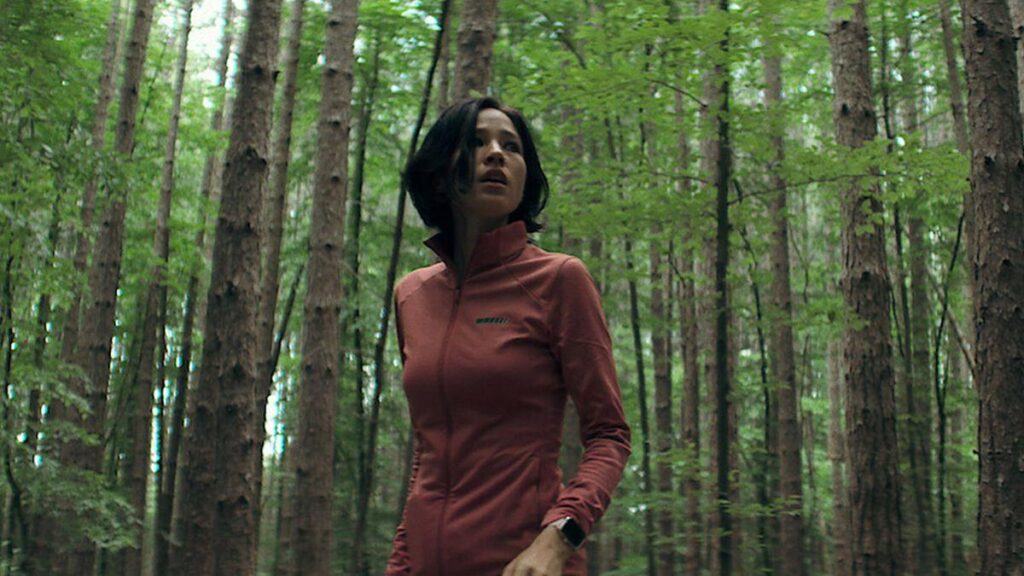
Directed by Brian Netto and Adam Schindler and produced by Sam Raimi, the 2024 Netflix thriller stars Kelsey Asbille as Iris, a grieving mother whose encounter with a seemingly sympathetic stranger turns into a fight for survival. Finn Wittrock plays Richard, the predator who injects Iris with a paralytic agent that slowly shuts down her body.
It is a simple concept, but Don’t Move gets considerable mileage out of it.
The movie isn’t particularly interested in reinventing the survival-thriller genre. Instead, it takes a familiar setup and imposes one brutal limitation on its protagonist: Iris has less and less control over her own body as the movie progresses.
That ticking clock is what makes the film work.


A simple premise with a nasty hook
Iris begins the film in an extremely vulnerable state. She is grieving the death of her young son and has traveled into the wilderness carrying an enormous amount of emotional pain.
There, she encounters Richard.
At first, he appears to be a stranger offering compassion at exactly the moment she needs it. But Richard is actually a serial killer, and his apparent kindness is simply another part of his manipulation.
After injecting Iris with the paralytic drug, Richard tells her that she has roughly 20 minutes before its effects take hold. From there, the movie becomes a race against her own nervous system.
It is a clever way to create suspense without constantly relying on jump scares.
Every movement matters.
Every second matters.
And eventually, even something as simple as speaking becomes a struggle.
Kelsey Asbille carries the movie
The biggest challenge of Don’t Move is also its greatest strength.
For long stretches, Kelsey Asbille has to perform while barely moving.
That could easily become monotonous, but Asbille finds ways to communicate Iris’ fear, desperation and determination through tiny facial movements and her eyes.
Netflix’s behind-the-scenes material notes that Asbille had to perform with much of her physical expression deliberately restricted, making the role especially demanding.
Her performance gives the movie an emotional center that the screenplay occasionally lacks.
Iris isn’t simply trying to escape a murderer. She is also fighting her way out of a psychological state in which she had already given up on herself.
The physical paralysis becomes a metaphor for the emotional paralysis caused by grief.
That isn’t particularly subtle, but it gives the movie more weight than a standard cat-and-mouse thriller.


Finn Wittrock makes Richard genuinely unsettling
Finn Wittrock has the easier role in some ways, because Richard gets to move, talk and dominate scenes.
But Wittrock makes the character effective precisely because Richard isn’t presented as a screaming, one-dimensional psychopath.
He’s conversational.
He’s manipulative.
And, perhaps most disturbing of all, he seems to believe his own twisted explanations for what he does.
Richard sees himself as someone trying to understand his own darkness. His conversations with Iris become increasingly disturbing as he attempts to justify his actions and explain the trauma that he claims transformed him.
Wittrock gives the character enough charm to make the early deception believable.
That’s important.
If Richard immediately seemed dangerous, the movie would lose much of its central tension.


The movie’s best sequences understand restraint
The strongest scenes in Don’t Move are the ones where the filmmakers trust the premise.
Once Iris is losing control of her body, even ordinary situations become terrifying.
A car ride.
A house.
A phone call.
A stranger approaching.
The movie repeatedly turns everyday objects and locations into potential survival tools.
One particularly effective element is the way Iris becomes increasingly dependent on other people while being unable to communicate normally. The film’s roughly real-time structure keeps the pressure on, with the filmmakers deliberately constructing increasingly difficult obstacles for Iris to overcome.
That is exactly the kind of scenario the film’s premise was designed to create.
Where Don’t Move starts to stumble
Unfortunately, the movie doesn’t always maintain the same level of discipline.
The premise creates very specific rules about Iris’ paralysis, but some of the later developments stretch credibility.
Critics have also pointed to inconsistencies surrounding the drug’s effects and the way certain sequences play out. The Guardian, for example, praised the film’s concept and momentum while criticizing inconsistencies in the rules governing Iris’ condition.
That’s the problem with a high-concept thriller.
Once you establish strict rules, audiences start paying attention to them.
If the character can move one part of her body at one point but seemingly cannot do so later, or if the timeline feels flexible when the entire story is built around a countdown, the tension begins to weaken.
The movie also occasionally falls into the familiar thriller trap of having characters make questionable decisions simply because the plot needs another obstacle.


The horror is more psychological than visceral
Despite its Netflix horror-thriller classification, Don’t Move isn’t primarily a gore showcase.
Its most effective weapon is helplessness.
Iris knows exactly what is happening to her, but she cannot necessarily do anything about it.
That’s an especially nasty horror concept because it attacks something audiences normally take for granted: control over your own body.
The film also connects that physical helplessness to Iris’ grief.
At the beginning, she is emotionally frozen.
By the end, she has rediscovered her instinct to survive.
Netflix’s production material describes the movie as a story about Iris rediscovering her desire to live, and that interpretation helps explain why the premise works better thematically than the screenplay sometimes suggests.
The ending gives the story its emotional payoff
Spoilers ahead.
Iris eventually manages to turn the tables on Richard.
After surviving his attempts to kill her, she wounds him and escapes.
The most interesting moment comes afterward.
Iris kneels over Richard and says, “Thank you.”
The line echoes Richard’s own disturbing history and his warped explanation of the moment when he discovered his murderous nature.
But for Iris, the meaning is different.
She is essentially thanking Richard for forcing her to rediscover the instinct to live.
It’s a dark, uncomfortable conclusion, but it works.
The woman who began the film believing she had nothing left to live for has fought through an unimaginable series of circumstances to survive.
The killer unintentionally gave her back the thing she had lost.

Final Verdict
Don’t Move isn’t a groundbreaking horror movie, but it doesn’t need to be.
Its strength comes from taking one strong idea and squeezing as much tension out of it as possible.
Kelsey Asbille gives the film a committed central performance, Finn Wittrock makes for a compellingly sinister antagonist, and the directors find clever ways to turn physical helplessness into suspense.
The movie does have problems. Some character decisions strain credibility, the rules surrounding the paralysis aren’t always consistent, and the screenplay occasionally feels thinner than its excellent premise deserves. Critics were divided for similar reasons, with Rotten Tomatoes and other reviews reflecting a generally mixed-to-positive response.
Still, Don’t Move succeeds at the most basic requirement of a thriller:
It makes you want to know what happens next.
And when Iris can barely move, that’s no small accomplishment.
Final Rating: 7.5/10
Bottom line: Don’t Move is a lean, suspenseful Netflix survival thriller elevated by Kelsey Asbille’s performance and a genuinely effective central gimmick. It doesn’t completely stick the landing, but there’s enough tension, atmosphere and psychological horror here to make it worth the investment.