Spoilers ahead for Season 1 of Netflix’s A Different World.
Nearly four decades after A Different World first introduced audiences to the fictional Hillman College, Netflix brings the beloved HBCU setting back to television with a new generation of students—and the results are a surprisingly thoughtful continuation of the franchise.
The new A Different World is technically a sequel rather than a traditional reboot. The story follows Deborah Wayne (Maleah Joi Moon), the daughter of Dwayne Wayne and Whitley Gilbert, as she begins her freshman year at her parents’ alma mater. She arrives at Hillman carrying an enormous family legacy while desperately trying to establish an identity of her own.
The first season consists of 10 episodes, introducing a new ensemble while bringing back several familiar faces from the original series.
A New Generation Has Arrived
The biggest challenge facing the Netflix series is obvious: How do you create something new while following one of television’s most recognizable college sitcoms?
Fortunately, Season 1 doesn’t simply attempt to recreate the original.
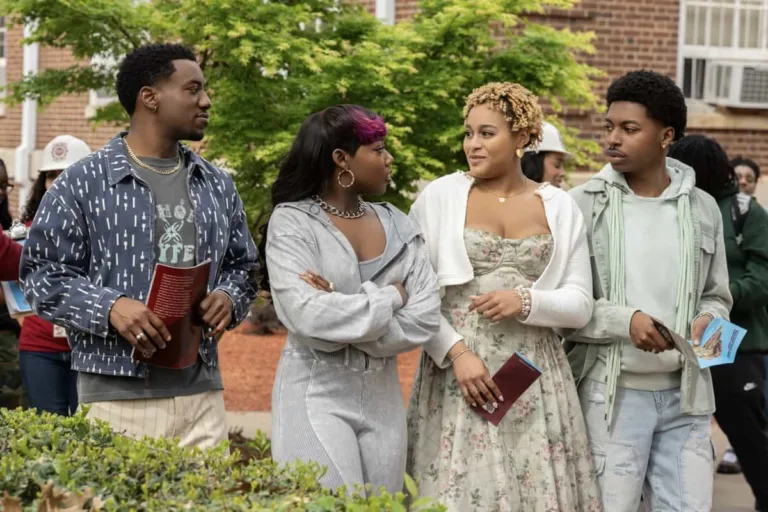
Deborah is surrounded by a completely new group of students, including Rashida Duvall (Alijah Kai), Shaquille Johnson (Cornell Young IV), Amir (Jordan Aaron Hall), Kojo (Chibuikem Uche), and Hazel (Kennedi Reece). Each character arrives at Hillman with different ambitions, personalities and challenges.
The result is an ensemble that gradually becomes more interesting as the season progresses.
Rashida is particularly effective as a contrast to Deborah. She’s a first-generation college student who approaches school with an intensity that initially puts her at odds with her roommate. Their differences become an important part of the show’s emotional foundation.
Deborah Wayne Has Big Shoes to Fill
Maleah Joi Moon has perhaps the hardest assignment of the entire cast.
Deborah isn’t just another freshman. She’s the daughter of two of the most recognizable characters in A Different World history.
The series wisely makes that pressure part of Deborah’s story.
Instead of making her simply a younger version of Whitley or Dwayne, the show gives Deborah her own personality and ambitions. She’s artistic, outspoken and determined to demonstrate that she belongs at Hillman because of who she is—not because of her parents.
That struggle gives Season 1 a strong emotional throughline.
The Returning Cast Is Used Carefully
One of the smartest decisions is that the original characters don’t completely take over the series.
Kadeem Hardison returns as Dwayne Wayne, while Jasmine Guy reprises her iconic role as Whitley Gilbert. Darryl M. Bell and Cree Summer also return, with other familiar faces appearing throughout the season.
Their appearances provide nostalgia, but they also serve a story purpose.
Dwayne and Whitley are no longer college students trying to figure out their futures. They’re parents watching their daughter experience many of the same complicated emotions they once experienced themselves.
That generational perspective gives the sequel its reason to exist.
The HBCU Setting Still Matters
The greatest strength of A Different World has always been its ability to portray Black college life as something larger than a backdrop.
The Netflix series continues that tradition.
Hillman is presented as a place where students can debate, fall in love, make mistakes, discover themselves and confront difficult issues while still experiencing joy.
That balance is important.
The new series doesn’t treat its characters as representatives of a single Black experience. Instead, it gives them different personalities, backgrounds and goals.
The production was also filmed at the Atlanta University Center, helping provide an authentic visual connection to the HBCU environment.
Comedy vs. Drama
This is where Season 1 is somewhat uneven.
The original A Different World eventually became famous for balancing comedy with serious social commentary. Netflix’s version attempts a similar formula, but some episodes lean more heavily into relationship drama than sitcom humor.
That isn’t necessarily a bad thing, but viewers expecting the rapid-fire comedic energy of the original may find the new series more dramatic.
Several critics have noted that the reboot occasionally struggles with that balance. TVLine, for example, argued that the show’s dramatic tendencies sometimes overwhelm the lighter material.
Other critics have been considerably more enthusiastic, praising the new ensemble and the show’s heartfelt storytelling.
The truth is somewhere in between: Season 1 doesn’t always nail the balance, but when the comedy and character drama work together, the series feels very much like A Different World.
The Nostalgia Factor
There is no avoiding nostalgia.
References to the original series are everywhere, and longtime fans will recognize familiar characters, locations, relationships and callbacks.
But the reboot is at its strongest when it stops looking backward.
The new students are compelling enough that the show doesn’t need to constantly remind viewers of what came before.
That’s particularly important because Deborah’s story works best when she’s allowed to be Deborah—not simply “Dwayne and Whitley’s daughter.”
The Season 1 Ending
The finale leaves the door open for more story rather than wrapping everything into a neat conclusion.
That approach makes sense for a show about college life. These characters are only beginning to figure out who they are.
The season also leaves a particularly intriguing question surrounding the original generation, including a cliffhanger involving Denise Huxtable that has already generated discussion about whether Lisa Bonet could return.
That kind of cliffhanger is clearly designed to keep both longtime viewers and newcomers interested in what comes next.
Final Verdict
A Different World Season 1 isn’t a carbon copy of the classic sitcom—and that’s ultimately a good thing.
The Netflix series has some growing pains. At times, the drama becomes heavier than necessary, and the show occasionally relies too heavily on nostalgia. But the new cast has chemistry, the HBCU setting remains meaningful, and Deborah Wayne provides a strong central character for the next generation.
Most importantly, the series understands that the goal shouldn’t be to recreate the past.
It should be to show what a different world looks like for a different generation.
And by the end of Season 1, Netflix’s A Different World has established enough of its own identity to make Hillman feel worth returning to.
Final Rating: 8.5/10
The Bottom Line: A warm, ambitious and occasionally uneven sequel that successfully introduces a new generation to Hillman while respecting the legacy of the original. The new cast is strong enough to carry the franchise forward, and Season 1 leaves plenty of room for the series to grow.