

5
Rating: 7/10
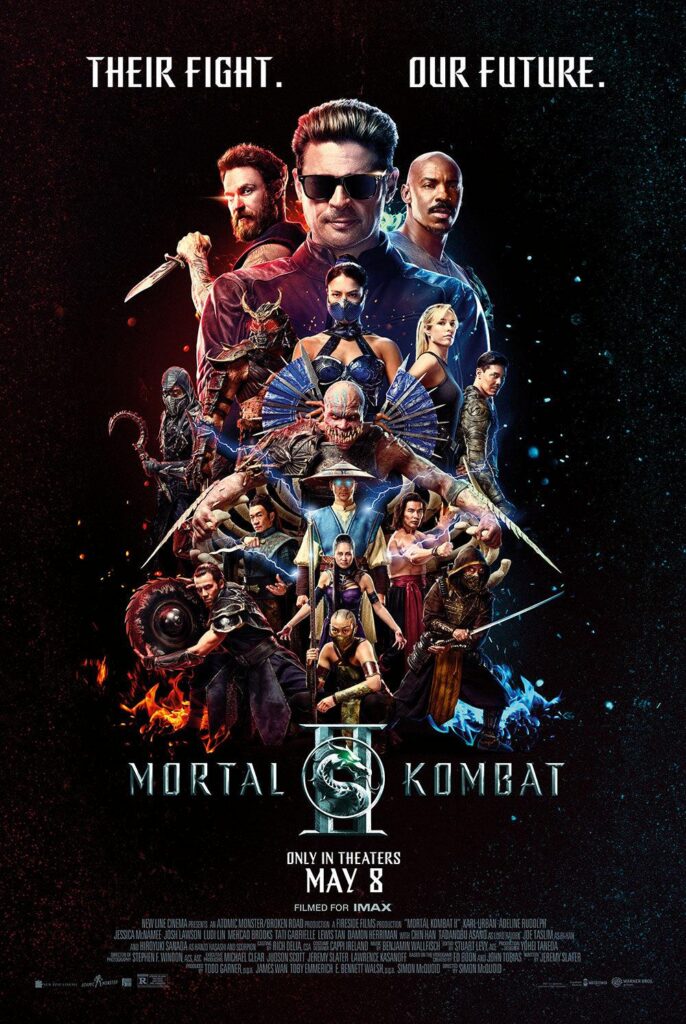
After years of waiting, Mortal Kombat II finally gives audiences what the previous film conspicuously withheld: the tournament itself. Directed by Simon McQuoid and featuring the much-anticipated arrival of Johnny Cage, the sequel is bigger, bloodier and considerably more confident about what kind of movie it wants to be.
That confidence is both its greatest strength and its principal limitation.
Mortal Kombat II understands that audiences aren’t necessarily coming for intricate plotting or restrained fantasy drama. They’re coming to see iconic fighters collide, supernatural abilities explode across the screen and the franchise’s famously brutal combat receive an appropriately R-rated treatment. On those terms, the film is frequently successful.
A Sequel That Listens to Its Audience
One of the most significant improvements over the 2021 film is structural. The original Mortal Kombat spent much of its runtime assembling its characters and establishing its mythology, only to stop short of staging the tournament audiences expected.
The sequel corrects that course.
The tournament framework gives the film a much clearer dramatic engine, allowing its large ensemble of fighters to interact and, more importantly, fight. Critics have generally recognized this improvement, with several reviews describing the sequel as a more confident and entertaining follow-up despite its narrative shortcomings.


Karl Urban Gives the Film Its Personality
The most notable addition is Johnny Cage, played by Karl Urban. Rather than simply functioning as another fighter on an increasingly crowded roster, Urban provides the movie with much-needed comic energy.
His performance gives Mortal Kombat II a different rhythm. Johnny’s arrogance and self-awareness create opportunities for humor without completely undermining the seriousness of the surrounding mythology. The result is one of the film’s most effective tonal elements.
Several critics have singled out Urban as a highlight, with TheWrap specifically praising the actor for bringing a playful, Galaxy Quest-like energy to the franchise.
The Action Finally Takes Center Stage


4
If there is one area in which Mortal Kombat II unquestionably understands its assignment, it is the action.
The fights are larger in scale and more closely aligned with the spectacle fans associate with the games. Fatalities, elaborate powers and one-on-one confrontations give the movie an episodic quality that feels almost intentionally game-like.
That approach does come with a cost. The screenplay often feels as though it exists primarily to connect one major fight to the next. Game Informer, while praising the choreography and fatalities, similarly noted that the story is relatively thin and that the pacing remains uneven.
But for a franchise built around combat, that isn’t necessarily a fatal flaw.
The question is whether the fights are entertaining enough to justify the material between them. More often than not, they are.
Where the Movie Falls Short
The screenplay remains the film’s weakest element.
With so many characters, factions and pieces of mythology competing for attention, Mortal Kombat II occasionally feels less like a cohesive fantasy adventure than an extended showcase for its roster. Emotional stakes are sometimes asserted rather than earned, while the increasingly complicated mythology can make the consequences of death and victory feel less permanent than they should.
That criticism has been echoed across the critical response. Rotten Tomatoes currently lists the film at 64% from critics and 86% from audiences, reflecting a noticeable divide between reviewers who find the storytelling thin and viewers primarily interested in the franchise’s action and fan service.


The Verdict
Mortal Kombat II isn’t interested in reinventing the video-game adaptation. Instead, it takes the lessons of its predecessor and moves decisively toward what fans wanted in the first place.
The result is an occasionally clumsy but undeniably energetic action sequel. Its narrative is functional rather than sophisticated, and its enormous cast isn’t always given enough room to breathe. Yet when the film unleashes its fighters, embraces its absurd mythology and lets the violence take over, it becomes exactly the kind of unabashed genre spectacle the franchise has always promised.
It may not achieve a flawless victory, but it gets considerably closer than its predecessor.
Final Rating: 7/10
The bottom line: Mortal Kombat II is a substantial improvement in spectacle and fan service, elevated by Karl Urban’s Johnny Cage and some impressive combat sequences, even if its thin story keeps it from becoming more than a very entertaining genre blockbuster.