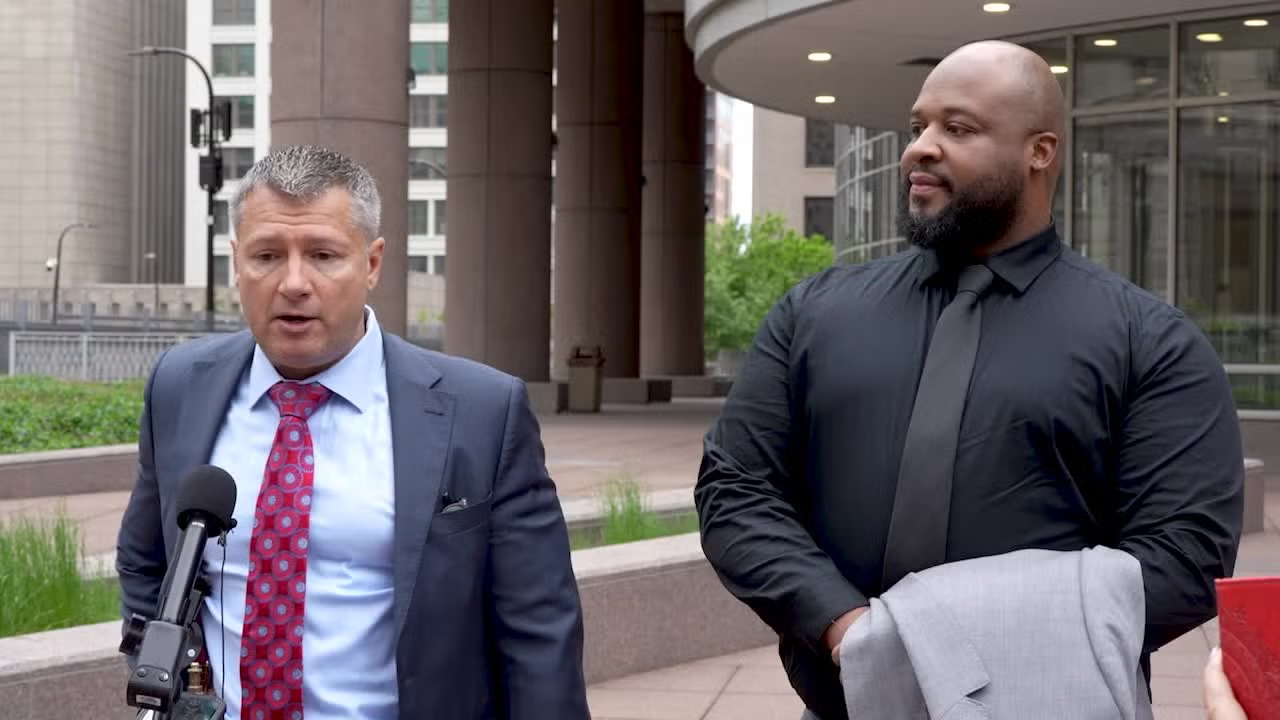
“I knew it. I knew politics were going to come into this.”
That was the first thing defense attorney Ryan Pacyga had to say after U.S. Immigration and Customs Enforcement agent Gregory Morgan Jr.’s first appearance before a Minnesota judge Friday afternoon.
Pacyga was talking about when a Hennepin County prosecutor mentioned the troubles they’ve been having getting records from the Department of Justice.
“The Hennepin County attorney’s displeasure or fight that they’re having with the Department of Justice and other cases that shouldn’t have come into the — to today’s hearing,” Pacyga said.
In April, prosecutors charged Morgan with two counts of second-degree assault with a dangerous weapon for an incident in February during Operation Metro Surge. In court filings, prosecutors said Morgan pointed his gun at two Minnesotans in another car.
Morgan turned himself in and posted bond on Thursday.
Conditions of release
Friday’s court appearance lasted maybe 15 minutes. The only real question was about what conditions would accompany Morgan’s $100,000 bond that keeps him out of jail while the case is prosecuted.
In the end, at least one condition will impact his job as an ICE agent: Prosecutors asked Judge Paul Scoggin to ban Morgan from possessing any firearms.
Morgan’s attorney asked for a compromise, banning him from guns while traveling or in Minnesota but letting him have his service weapon in Maryland, where Morgan still works as an ICE agent.
Scoggin said he wasn’t going to alter his normal procedure in cases where the presumed penalty is more than a year behind bars and ordered a full gun and ammunition ban.
Pacyga said he’s not sure what that will mean for Morgan’s job yet.
“We’ll have to confer with ICE and determine how important that is or isn’t to them, right? So, I don’t know what that’s going to be,” he said.
Minnesota defense attorney Eric Nelson, who defended Derek Chauvin during his murder case, said a ban on carrying a weapon doesn’t mean a complete ban on working as a law enforcement officer.
“Whether it’s a state or federal officer, if there’s a prohibition on possessing firearms … he could just simply be placed on an administrative duty,” Nelson said. “He’s presumed innocent of the charges, and if he … successfully defends against the charges, he would be allowed to return to work and possess firearms.”
Scoggin also banned Morgan from traveling outside of the country and having contact with any of the witnesses, including his partner that day who works in the same building as Morgan in Maryland. The judge made it clear the ban on contact was about having conversations or discussing the case, not on seeing each other in passing.
The conditions placed on Morgan may only be temporary. Under Minnesota state law he has the right to pay a higher bond to secure an unconditional release. His attorney said Friday that’s a decision Morgan will make at a later date. It would cost him another $10,000 out of pocket.
The prosecution had just one thing to say about Friday’s first appearance.
“We are glad that this process has started, and look forward to debating this case in court,” said Morgan Kunz from the Hennepin County Attorney’s Office.
Federal vs. state
Local legal experts told 5 EYEWITNESS NEWS this case is, in large part, a political fight starting with why the state charged Morgan in the first place.
“This … generally would have been brought by federal authorities against a federal officer,” said Bradford Colbert with the Mitchell Hamline School of Law. “We are, I think it’s fair to say, in uncharted territory as far as how this is going to progress.”
He said the last U.S. Supreme Court ruling that would have an impact on a case like this came a century ago, in the 1920s.
“There should be a cooperation between the state government and the federal government, but that is just not happening,” Colbert explained.
The defense says its next step is to ask a judge to move the case from state to federal court. They have 30 days to do that.
“We remain undeterred,” Pacyga said. “We’re just going to keep following the process and trust the court process. We’re going to trust the judges down the road, and if this case ever gets to a jury, we’re going to trust the jury.”
Pacyga wouldn’t elaborate on why they’re seeking a change of venue, but Nelson suggested it likely has to do with the expected defense.
“He would have to claim a federal defense, which would be, in this case, potentially qualified immunity, or that he was acting within the scope of his federal job, federal duties and is entitled to greater protections under federal law,” Nelson explained.
But moving the case to federal court could have some odd implications for the case.
“It’s kind of setting up a federal-state fight in that regard. I think that’s an important concept,” Nelson said.
“They can remove it to federal court, where it will be heard by a federal judge, but prosecuted by a state prosecutor, which again, which is a really unusual area,” Colbert said.