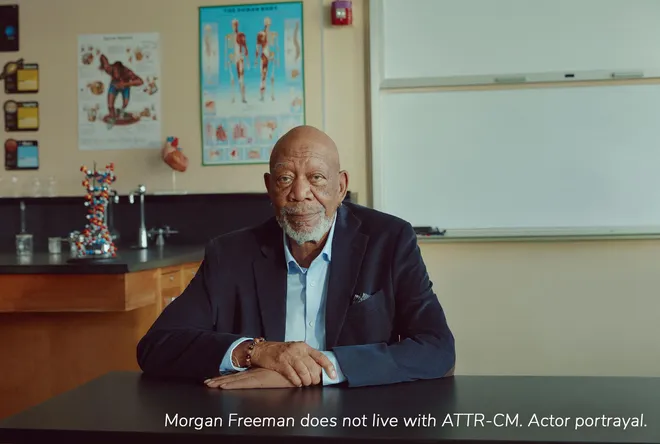
Through a partnership with BridgeBio, the celebrated actor is ‘the voice’ of awareness.
Please see Important Safety Information for Attruby® (acoramidis) below. Visit Attruby.com for the Patient Information and Full Prescribing Information for Attruby.
His voice is easily among the most recognizable in the world. Award-winning actor Morgan Freeman has a presence that can command a room without stepping into it. On and off screen, his steady baritone carries calm authority, narrating everything from nature documentaries to the voice of God himself. He speaks with the confidence of someone who sees the big picture.
Now, Freeman is speaking out on the importance of heart health – specifically, a serious and progressive heart condition called ATTR-cardiac amyloidosis, or ATTR-CM, and a treatment option, Attruby, which is used to help slow disease progression in adults with ATTR-CM.
“Although I don’t have ATTR-CM, I have experienced a heart condition,” said Freeman. “And so now I feel that speaking from the heart, so to speak, has an even more profound meaning.”
Still active in the film industry as he approaches his 90s, Freeman understands the value of staying fit and working closely with health care professionals to support his well-being. He knows it’s not always easy.
“Older adults should feel encouraged to advocate for their personal health and work with their health care professionals to live their most full and healthy lives,” he said.
Through the campaign with Attruby, increasing awareness of ATTR-CM is a step toward empowering others.

Turning the spotlight on ATTR-CM
While Freeman’s voice is unmistakable, the symptoms of ATTR-CM aren’t always so distinctive, making the condition easy to overlook or misdiagnose. In its early stages, transthyretin (TTR) amyloid cardiomyopathy, or ATTR-CM, can look like other heart conditions. Symptoms may include shortness of breath, swelling in the feet or legs, digestive issues, weakness, nerve pain, irregular heartbeat and even carpal tunnel syndrome.
“Rare health conditions like ATTR-CM can hide in plain sight, which is why awareness matters and why I’m working with BridgeBio to encourage people who may have ATTR-CM to learn more and talk to their health care professionals,” said Freeman.
ATTR-CM can be hereditary (running in families) or “wild-type,” which develops naturally with age. For the hereditary form, about 1 in 25 Black Americans carries a V122I genetic variant linked to the disease. While there are many other mutations, not all who carry this variant will develop ATTR-CM, explained Dr. Nitasha Sarswat, director of the infiltrative cardiomyopathy program at the University of Chicago Hospitals.
While the causes of wild-type ATTR-CM are not fully understood, it tends to occur in people older than 65 and is more common in men than women. However, it may be underdiagnosed in women, Sarswat said.
On reaching different communities, especially those at risk for heart disease, Freeman said, “I know my voice is relevant to people. Everyone deserves to be heard by their health care professionals.”

‘Catching’ it early can help improve outcomes
Over time, ATTR-CM can lead to heart failure. “Ideally, we’d like to catch people before that,” said Sarswat. “Early detection is important because we know that patients who are treated earlier do better in terms of how they live, compared to patients not treated or treated later in the disease.”
Freeman echoed that message. “If you have a health professional, talk to them. If you don’t have one, get one. It’s never too late. Don’t assume your symptoms are just part of aging, as they can be shared with other heart conditions. The more you know, the better chance you have to take action early.”
In people who develop ATTR-CM, the condition occurs when TTR, a protein that supports many important tasks in the body, including transporting vitamin A and the hormone thyroxine, becomes unstable, breaks apart and misfolds. Those misfolded proteins build up in the heart, leading to problems with the heart muscle, explained Sarswat.
When left untreated, ATTR-CM can affect overall health, limit daily activities and reduce time spent with friends and family. Fortunately, there’s treatment for adults with ATTR-CM, explained Sarswat.
“We are diagnosing people earlier and we have effective treatments,” she said. “The current treatments help people live longer and stay out of the hospital.”

A path forward for people with ATTR-CM
While ATTR-CM is not curable and gets worse over time, there is a lot of promise for patients through medical treatment and lifestyle changes.
“Compared to 10 years ago, life for people with ATTR-CM is changing. There are treatments available,” Sarswat shares. “I have patients who are active in the community.”
One of the treatments that Dr. Sarswat prescribes for her patients with ATTR-CM is Attruby. “Attruby is a prescription medication shown to help adults with ATTR-CM live longer and have fewer hospitalizations due to heart issues,” says Sarswat.
Attruby works by helping to strengthen and stabilize the bonds of the TTR protein so that it’s less likely to break down and form misfolded proteins that build up in the heart. Attruby worked quickly, with lab tests showing that the bonds of the TTR protein were stabilized in as early as 4 weeks and sustained through the end of the 30-month clinical study in people with wild-type and hereditary ATTR-CM (lab results are not a direct indicator of clinical benefit).
Possible side effects of Attruby include diarrhea and abdominal pain. In the clinical study, these were generally mild and went away over time for most people.
In addition to treatment, lifestyle can play an important role in heart health. Sarswat explained how people with ATTR-CM can talk to their doctors about improving their diet, such as increasing protein and minimizing salt intake, and about the importance of exercise and movement.
Both Freeman and Sarswat emphasized the importance of speaking up, whether it’s to a healthcare professional or friends and family.
“Sometimes speaking up about your health questions can make all the difference,” said Freeman.
Sarswat points out that raising awareness of ATTR-CM can help lead to better outcomes.
“We as a medical community are constantly learning more about ATTR-CM and we’ve made a lot of progress but still have a lot to learn,” she said. “Patients and families can help to improve awareness of the disease in the community, which can help promote earlier diagnosis and may lead to better outcomes.”
If there’s one lesson to take from Hollywood, it is that when Morgan Freeman speaks, it is wise to listen.
Learn more about ATTR-CM and Attruby and hear more from Morgan at https://www.attruby.com.
What is Attruby?
Attruby is a prescription medicine used to treat adults with a disease that affects the heart muscle called cardiomyopathy of wild-type or variant transthyretin-mediated amyloidosis (ATTR-CM), to reduce death and hospitalization related to heart problems.
It is not known if Attruby is safe and effective in children.
IMPORTANT SAFETY INFORMATION
Before taking Attruby, tell your healthcare provider about all your medical conditions, including if you:
• are pregnant or plan to become pregnant
• are breastfeeding or plan to breastfeed
Tell your healthcare provider about all the medicines you take, including prescription and over-the-counter medicines, vitamins, and herbal supplements.
What are the possible side effects of Attruby?
The most common side effects of Attruby were mild and include:
• diarrhea
• stomach-area (abdominal) pain
These are not all of the possible side effects of Attruby.
Call your doctor for medical advice about side effects. You may report side effects to FDA at 1-800-FDA-1088 or www.fda.gov/medwatch.
For the Full Prescribing Information and Patient Information for Attruby, visit Attruby.com/PI.
Attruby®, the Attruby logo, and the BridgeBio Pharma, Inc. corporate logo are trademarks of BridgeBio Pharma, Inc.
© 2026 BridgeBio Pharma, Inc. All rights reserved. MAT-US-ACO-1361 V1