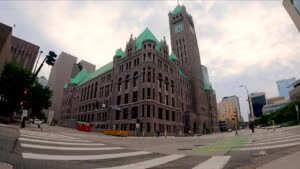
A coalition of Minneapolis City Council members and community leaders are raising doubt that a proposed $38 million training and wellness complex for first responders is the best use of taxpayer dollars.
Late last month, Mayor Jacob Frey’s administration put forth the plan for a dedicated space to train employees under the Community Safety umbrella, including police, firefighters, 911 dispatchers and behavioral crisis response staff.
Advocates say the centralized facility is needed for better interdepartmental coordination. They also point to an assessment as part of the city’s settlement agreement with the Minnesota Department of Human Rights (MDHR), which identified a need for a new training center.
However, the progressive wing of the City Council isn’t convinced such a building is necessary.
During a news conference Monday morning, Council Members Aisha Chughtai, Soren Stevenson and Robin Wonsley contended the $38 million would be better spent elsewhere.
“I have a very simple question for everyone here and everyone at home: What would your community do with $40 million, and what kind of benefit could we get by investing $40 million in your community?” Stevenson said. He listed George Floyd Square and the former Lake Street Kmart site as examples of worthy development priorities.
The proposal calls for the training center to be funded through the city’s capital budget, with a hope for $19 million in matching funds from a state bonding bill. Community Safety Commissioner Todd Barnette has said the initial $6 million purchase of a parcel in the city’s Windom neighborhood would indicate to state lawmakers that the city is serious about following through with the project.
But as recent history has shown, there’s no guarantee a bonding bill would pass the Legislature, given such measures require a supermajority for approval.
In 2024, promised state bonding dollars would have helped a neighborhood group purchase the former Roof Depot site in the East Phillips neighborhood, but those funds didn’t pan out. Two years later, the future of the site is still in limbo.
Even if the city does get those coveted bonding dollars, opponents say taxpayers will still end up footing the bill.
“This is going to end up on the back of working-class residents through their taxes,” Wonsley said. “That is how we’re going to have to finance this. Even though we’re talking about fronting the purchase of this on our credit.”
Wonsley was also skeptical that such a facility would further the city’s progress on the MDHR consent decree, citing ongoing improvements to police precincts throughout Minneapolis.
“We’ve spent tens of millions on capital projects that actually are in alignment with what is being requested from the settlement agreement in terms of having better training space, wellness components to these centers, so many of these things are fulfilled,” Wonsley said.
In a statement, a city spokesperson said the $6 million to purchase the property at 146 W. 60th St. would be a reallocation of existing funds from the 2026 capital budget, and any remaining expenses would be “programmed into” the city’s capital budget.
The city added that the training center has been part of the city’s capital budget plan since 2021 and noted the City Council this year included funding for the project among its legislative bonding priorities.
“We are committed to ensuring that our community safety personnel have access to high-quality training and wellness resources to serve the public effectively and safely,” Barnette said in a statement. “We have all been recent witnesses to the importance of having properly trained law enforcement officers. This is a long-term investment in the people who serve our community every day, helping with safer responses and stronger coordination. I have been very clear in my conversations with all council members that this one-stop training and wellness center addresses critical facility gaps for all of the City’s community safety departments.”
The council will consider the property purchasing agreement later this month.